
Imagine stumbling upon a *10,000-year-old artifact* that remained in *pristine condition*, untouched by time. Sounds like a scene from an archaeological adventure novel, right? Yet, this incredible reality has unfolded at the depths of Lake Biwa in Japan, where researchers recently unearthed remarkably preserved *Jomon pottery*. The story behind its survival is as fascinating as the artifact itself.
Highlights
- 🌊 *Jomon pottery* found at the bottom of Lake Biwa dates back between 10,500 and 11,000 years.
- 🔍 Discovered during a survey with cutting-edge *autonomous underwater vehicle (AUV)* technology.
- 👀 The pot’s exquisite condition is unusual for archaeological finds, often damaged when excavated on land.
- 🧠 This discovery sheds light on early Japanese pottery traditions and underwater archaeology.
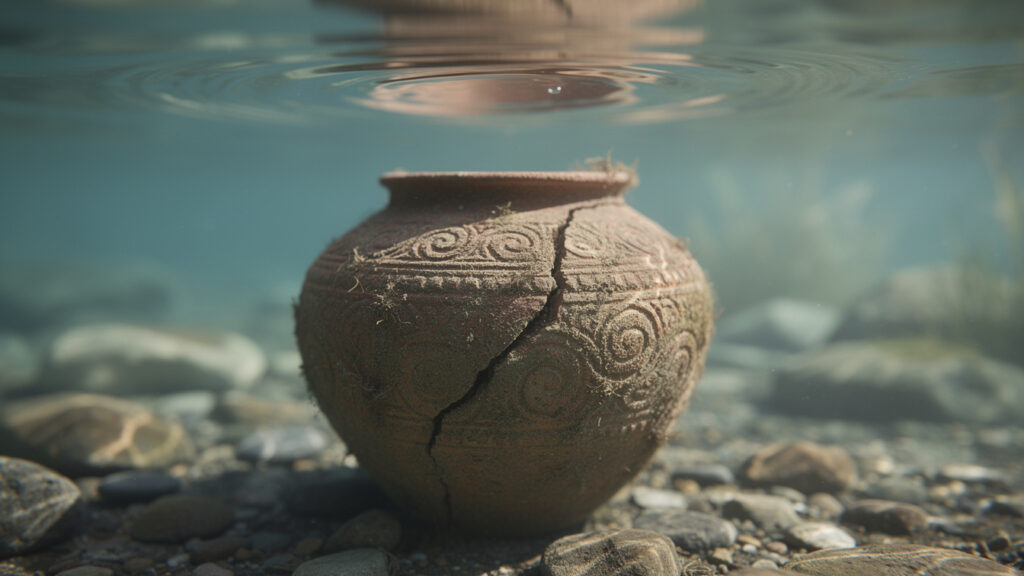
This stunning artifact was retrieved from a depth of approximately 64 meters, near the Tsuzuraozaki underwater site, a location already famed for yielding historical pottery. The vessel stands about 25 centimeters tall and showcases the distinctive characteristics of early Jomon-period ceramics, including a pointed base and beautifully engraved patterns. What’s astounding is that it retains almost all of its original form, a rarity in the world of *archaeology*.
Unveiling the History of Jomon Pottery
The term *Jomon* refers to a period in *Japanese history* characterized by its distinctive pottery. Archaeologists have identified this latest find as either part of the *Jinguji* style or the *Konami Upper-layer tradition*. These early techniques signify a crucial phase in Japan’s artistic evolution, as artisans transitioned from simple utility to vessels infused with cultural significance.
Some key features of the *Jinguji-style pottery* include:
- 🌀 Pointed bases
- 🌿 Soft contours and engraved designs
- ✨ Innovations in fired clay technology
Meanwhile, the *Konami Upper-layer style* is recognized for refined surface treatments and linear decorative patterns that emerged during the early phases of Jomon culture. Both styles highlight a pivotal shift in ceramic craftsmanship, marking Japan’s earliest experiments with fired clay.
Technological Breakthroughs Fueling Discovery
This groundbreaking archaeological find became possible due to state-of-the-art *AUV technology*, which is typically used for deep-sea exploration. Equipped with multiple cameras, this technology can create detailed underwater maps, narrowing down search areas effectively. The *autonomous underwater vehicles* used during the survey not only improved the precision of the mission but also showcased advanced capabilities that were once unimaginable.
Imagine navigating through murky waters with low visibility, yet producing data as clear as what divers could collect. That’s the magic of these modern systems. As explained by Yoshifumi Ikeda, a professor of underwater archaeology at Kokugakuin University, the data gathered during this survey was “comparable to what could be gathered by divers, even at depths exceeding 30 meters.”
Preservation in Water: Why This Pot Survived
Unlike pottery unearthed on land, which often arrives in shattered pieces, waterlogged artifacts maintain their structure remarkably well. The geological conditions of Lake Biwa play a significant role in this preservation. The vessel lay in a valley-like depression with minimal sediment accumulation, effectively protecting it from the elements. Continuous tectonic activity keeps the lakebed exposed, allowing artifacts like this one to remain in situ for millennia.
This extraordinary *survival* raises intriguing questions about the other potential discoveries waiting to be unsealed beneath the lake. The nearby remains of six *Haji pottery jars* from a much younger era further affirm the site’s rich historical layers, hinting at various uses and significances over the centuries.
A Site of Mystery and Untapped Potential
The Tsuzuraozaki underwater ruins have seen sporadic discoveries since the 1920s, with over 200 pottery fragments recovered to date. However, the site holds many mysteries yet to unravel—questions about ancient fishing communities, potential ritual deposits, or lakeside settlements altered by natural disasters add layers to this ongoing narrative.
As the research continues, scholars remain eager to explore the contextual significance of this well-preserved vessel. Each new discovery not only enriches our understanding of *Japanese history* but also highlights how technological advancements are reshaping *underwater archaeology*.
The Lake Biwa find exemplifies the fruitful union of *archaeology* and cutting-edge technology. With nearly 400 underwater archaeological sites scattered across Japan, the capabilities introduced by AUVs and high-resolution scanning signify a new era, one in which previously unreachable depths might reveal stories long hidden beneath the surface.