
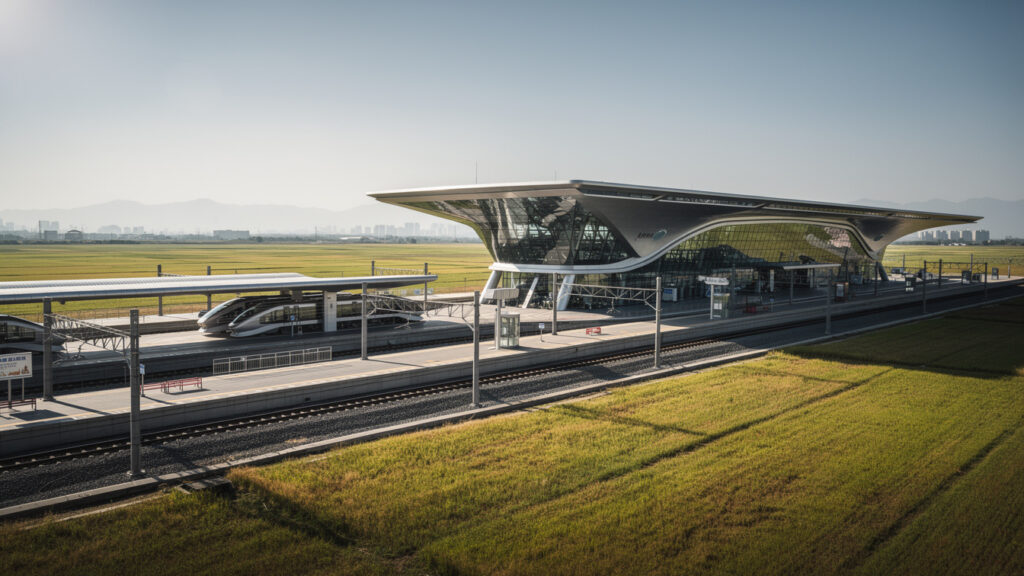

The year 2008 marked a peculiar chapter in urban planning that would unfold dramatically over the subsequent years. As China ramped up its infrastructure development in anticipation of the 2008 Olympics, it raised eyebrows worldwide by constructing metro stations in seemingly desolate areas—vast empty fields, devoid of any significant population. Critics labeled them “ghost stations,” mocking what they perceived to be a flawed strategy. But now, as we stand on the threshold of 2026, the narrative around these once-forlorn platforms has taken a compelling turn.
Highlights
- 🏗️ China built metro stations in empty fields as part of a long-term urban planning strategy.
- 📈 What seemed like a wasteful decision is now proving to be a cornerstone for economic growth.
- 🚆 These “ghost stations” have transformed into vital community hubs, reshaping local economies.
- 🛤️ The bold planning contrasts sharply with standard reactive urban development seen in much of the world.
In 2025, those once-empty metro stations are now at the heart of bustling neighborhoods where vibrant community life flourishes.
The Bold Decision to Build in Empty Fields
Back in 2008, while some ridiculed the idea of laying tracks leading to farmland, China was employing a long-range urban planning approach that many nations shy away from. While most of the world adopts a reactive stance—building infrastructure only in response to emerging demand—China forewent that model. They built transportation first with the expectation that city growth would follow.
This forward-looking strategy was built on meticulous planning. Documents from the 1990s laid out future sites for housing, educational institutions, and technological parks. Metro lines were precisely drawn to cater to what was, at the time, merely a blueprint for urban expansion.
Understanding the Economic Motive
The rationale behind this audacious plan was clear and driven by hard economic sense:
- 💰 Lower Costs: Early construction in vacant areas minimizes costs before property prices surge.
- 🌳 Access to Open Land: Rural plots are easier to acquire without the competitive pressures of urban real estate.
- 🚀 Accelerated Growth: Once a metro station is in place, developers can quickly erect housing, schools, and amenities.
- 📊 Economic Leverage: Anticipated future stations escalate land values, creatively financing further urban development.
The gamble paid off. After a period of waiting, local governments watched the surroundings spring to life, marking a significant turnaround from the previous skepticism directed toward the metro plans.
Transforming Spaces: The Evolution of Ghost Stations
Fast forward to today, and the transformation is remarkable. Those once-abandoned platforms now serve as gateways to dynamic economic zones:
- 🏡 Housing Hubs: Massive suburbs have sprouted around these metro stops, complete with schools, clinics, and shopping avenues.
- 💡 Innovation Zones: Provinces like Sichuan host tech campuses and research parks linked directly to metro access.
- 🎓 Educational Clusters: Universities established near these stations attract students and support local economies, contributing to a vibrant community.
This evolution didn’t happen overnight. Early residents often faced dust, constant construction, and infrastructural challenges as they settled into this developing landscape, relying heavily on the metro as their only functional link to the outside world. Interestingly, some stations have struggled to gain traction due to overestimated population projections or shifting government priorities.
Long-Term Success and Urban Planning Insights
The contrast between China’s ambitious planning strategy and the more conventional approaches of Western cities sheds light on essential lessons in urban development. In the U.S., underused train lines are often labeled white elephants, yet China has demonstrated that smart long-term planning can turn such “ghost stations” into thriving urban centers.
Here are some key takeaways:
- 🗺️ Preemptive Planning: Future transit systems should be intertwined with residential and commercial development from inception.
- 🚪 Space Preservation: Locking in sites for new stations before urban sprawl can ensure sustainable growth.
- 📈 Transparent Projections: Presenting clear data that indicates how ridership will grow is crucial for gaining political and public support.
- ⌛ Accepting Delays: A station’s full potential may not be realized for years, but this should not undermine the initial investment.
While the model presents its challenges, such as ensuring that the most vulnerable populations are not priced out of these developments, the successes of these “ghost stations” showcase the potential for intelligent infrastructure to stimulate economic growth.
What Does the Future Hold?
As we march forward, the lessons from China extend beyond its borders, raising profound questions about how cities, not just in America but globally, should envision their future infrastructure. Should we build for today or lay down the foundational elements for the needs of tomorrow?
This question resonates deeply within the field of urban planning today. Simulations are now employed to predict the impacts of opening metro lines a decade earlier than expected, allowing urban planners to visualize shifts in commuter habits, real estate preferences, and economic opportunities in real-time.
So, next time you stumble upon a new metro station seemingly sprouting from nowhere, it might just be a powerful signal of a community poised for growth and transformation.